

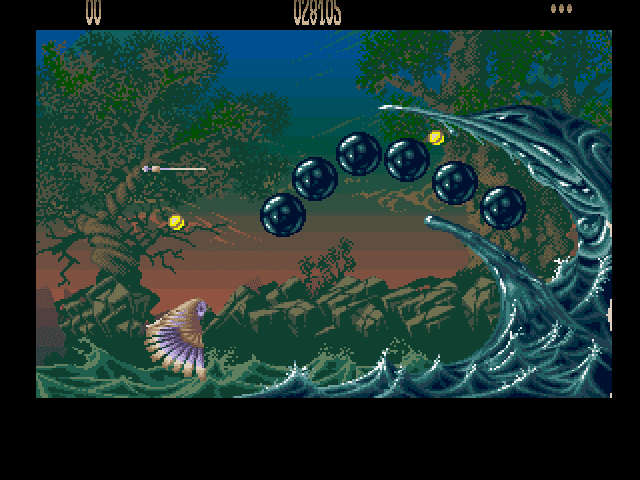
Hidden behind one of the most unapologetically Heavy Metal box covers of the era lies Agony, quite possibly the prettiest horizontal-scrolling shooter ever released on the Amiga. In 1992 it was downright haunting, with its layers upon layers of parallax scrolling, moody background art, and a bestiary of insectoid, draconic, and outright ghastly creatures. The world-building was so elaborate it felt like a fragment torn from a much larger, already fully realized universe.
Originally, the game was meant to ship with an additional disk containing an animated short that would flesh out the backstory. That plan was scrapped—presumably for budgetary reasons. What remains instead are the background animations woven into gameplay: crashing waves, trees bending under storm winds, dragon husks caught in fishing nets, and the ominous silhouette of a warrior atop a hill, drawing lightning into his sword. The result is a deeply atmospheric experience, rich with implication. You’re left asking the only reasonable question: what the hell is going on?
While opinions were divided on much of the bombastic in-game soundtrack, there was near-universal praise for the haunting piano ballad on the title screen, composed by Tim Wright. Years later, Stian Aarstad—then a member of the Norwegian black metal band Dimmu Borgir—was accused of plagiarizing the piece for parts of “Sorgens Kammer.” He admitted to it, left the band, and the track was subsequently removed from Stormblåst. A strange footnote, but a testament to how memorable that melody was.
Agony’s presentation is not flawless—enemy animations are stiff and unconvincing—but the ambition on display from developer Art & Magic is undeniable. At the time, it felt almost impossible that our beloved Amiga could pull off something this technically and artistically extravagant. Perhaps tellingly, this exact version of Agony was never ported elsewhere. Anyone attempting it would have had their work cut out for them.

Unfortunately, Agony is not particularly fun to play.
For a side-scrolling shooter, you control one of the strangest player vessels imaginable: Psygnosis’ own logo, an owl. By firing energy blasts and collecting power-ups in the form of protective swords and offensive spells, you’re expected to survive six short but punishing levels. Holding down the fire button while flying close to enemies maximizes your rate of fire—an odd design choice that makes you wonder why autofire wasn’t simply enabled by default.
The owl animates smoothly and responds well enough, but its hitbox is a nightmare to read. With its enormous wings constantly flapping and its body bobbing up and down, precise dodging becomes guesswork. In later levels, amid dense enemy fire and overlapping sprites, this becomes actively aggravating.

Sprite size only worsens the problem. From wingtip to wingtip, the owl occupies an absurd amount of screen space, and several enemies are even larger. With threats entering from nearly every direction, no warning cues, and one-hit deaths, the game veers into outright unfairness. The visuals are stunning, but they exact too high a price in playability. Dark backgrounds further compound the issue, with enemies often blending into the scenery. You’re punished not for poor reactions, but for failing to see what’s there.
Death is especially cruel. Losing a life strips you of a protective sword and downgrades your weapon, which all but guarantees failure from the fourth level onward. A more forgiving—and arguably smarter—design would have been to preserve upgrades and instead limit the player to a single life, awarding extra lives at fixed milestones.

Ironically, the boss fights swing to the opposite extreme. Several can be defeated by parking the owl in a single safe spot and holding fire, completely trivializing the encounter. Others are more engaging, but their limited patterns leave little room for surprise—especially if you make liberal use of the timed spells available.
So yes, I regret to report that Agony is a rather poor shooter. But as an artistic statement, I admire it deeply. Look at the loading screens. Take in the vast, empty landscapes. Listen to that haunting score. Agony may be the most inspiring bad game I’ve ever finished.
I wouldn’t recommend playing it yourself—but I would recommend watching it. Let someone else suffer through the mechanics while you appreciate the poetry in motion on your own terms. And while you do, remember this: Agony is nearly thirty years old, and it still looks like it fell out of someone’s fever dream.
Comments
Post a Comment