
A PSYCHOANALYST'S DREAM

The town of Silent Hill, where your deepest emotional scars manifest around you, is one of the original horror locations of the PlayStation ecosystem. Every visitor experiences the place in a personal way, resulting in monsters tailor-made to inflict maximum trauma. Silent Hill 2 is the finest story this town has produced, a psychoanalyst’s dream, where every piece of imagery and every puzzle theme serves as a clue to the enigma of the protagonist’s tormented mind.
Judging by the monsters he conjures, James Sunderland is a deeply disturbed man. Demons in straitjackets, nurses in revealing outfits, mannequins with an extra pair of legs where their torso should be - such are the waking nightmares that haunt him. Combined with the town’s oppressive decay, it paints a bleak and unsettling picture.


Drawn to Silent Hill by a letter from his wife, who supposedly died from illness three years earlier, James is riddled with doubt throughout the game. She couldn’t really be alive, could she? He retraces the places they once visited on vacation, jogging through run-down streets and searching abandoned buildings for any trace of her.
This time, the city looks as if it was abandoned in a hurry. Cars are left where they stood, most buildings are boarded up, and debris litters the streets. No one has tended to this place in a long time. A thick fog blankets everything, making navigation through the labyrinthine road network difficult. Many paths end abruptly at impassable scaffolding, while others end at bottomless chasms. The town appears open, but it soon becomes clear that you’re being funneled down a linear path.


Other people are drawn here too, each hounded by their own past. You encounter them repeatedly—Eddie, Angela, Maria, and Laura—each affected, or seemingly unaffected, by the town in different ways. Conversations often feel oddly detached, perhaps suggesting overlapping or alternate realities. Their versions of Silent Hill seem to function differently from yours.
Maria is of particular interest: an enchantress bearing an uncanny resemblance to James’s wife. She stands out as one of the few sources of color and warmth in an otherwise desaturated world.
This is, of course, a remake of the 2002 game of the same name, and it treats the original story with great respect while adding its own interpretations. Rather than rewriting the narrative, it expands upon it. Numerous buildings that were once inaccessible are now open for exploration, allowing you to scavenge ammunition, health items, and weapons.
The faithful approach is a relief, especially given that the original game features one of the most uncompromisingly bleak storylines in gaming. Even if its traditional survival-horror mechanics have aged, the narrative alone secures its place among my favorite games of all time.


In this reimagining, Bloober Team applies the Resident Evil 2 remake treatment, shifting to a third-person perspective with over-the-shoulder aiming. From a navigational standpoint, the experience is far less bewildering than the original, and while the combat still isn’t great, it’s undeniably improved. Unfortunately, it’s also too frequent for my tastes. A lack of enemy variety soon makes encounters feel repetitive, and the recurring jumpscare of a mannequin lying in wait quickly grows tiresome.
James moves and aims like an ordinary man, burdened by realism, which heightens tension in close encounters. You can conserve ammunition by landing headshots or temporarily crippling enemies before finishing them off with melee attacks. By smashing store windows and car glass, you can scavenge supplies, and occasionally you’ll come across a more powerful firearm. James subtly turns his head toward nearby interactable objects - a clever way of helping you miss as little as possible.

Enemies can spawn almost anywhere: lurking in dark interiors, patrolling foggy streets, and later even crawling along walls. Your radio crackles with static as they draw near, a brilliant mechanic that doubles as both a gameplay cue and a source of dread. It’s the icing on an already superb sound design.
The ambient audio torments you with abstract metallic droning, while smashing an enemy with your pipe produces a disturbingly satisfying squelch. The atmosphere oscillates between depression and oppression, between eerie silence and overwhelming noise, while the excellent voice performances convey resignation and despair.
Enemy designs remain faithful to the original: the twisted sexuality of the nurses and leg mannequins, the sickly menace of the straitjacket patients. Pyramid Head stands as one of gaming’s most iconic antagonists - a force of raw violence, particularly toward female figures, seemingly bent on punishing James for reasons that remain deliberately obscure. Hidden behind his massive, rust-red pyramid helmet, he’s deeply unsettling to behold. A late-game boss encounter involving Angela, however, may be even more disturbing as an idea.
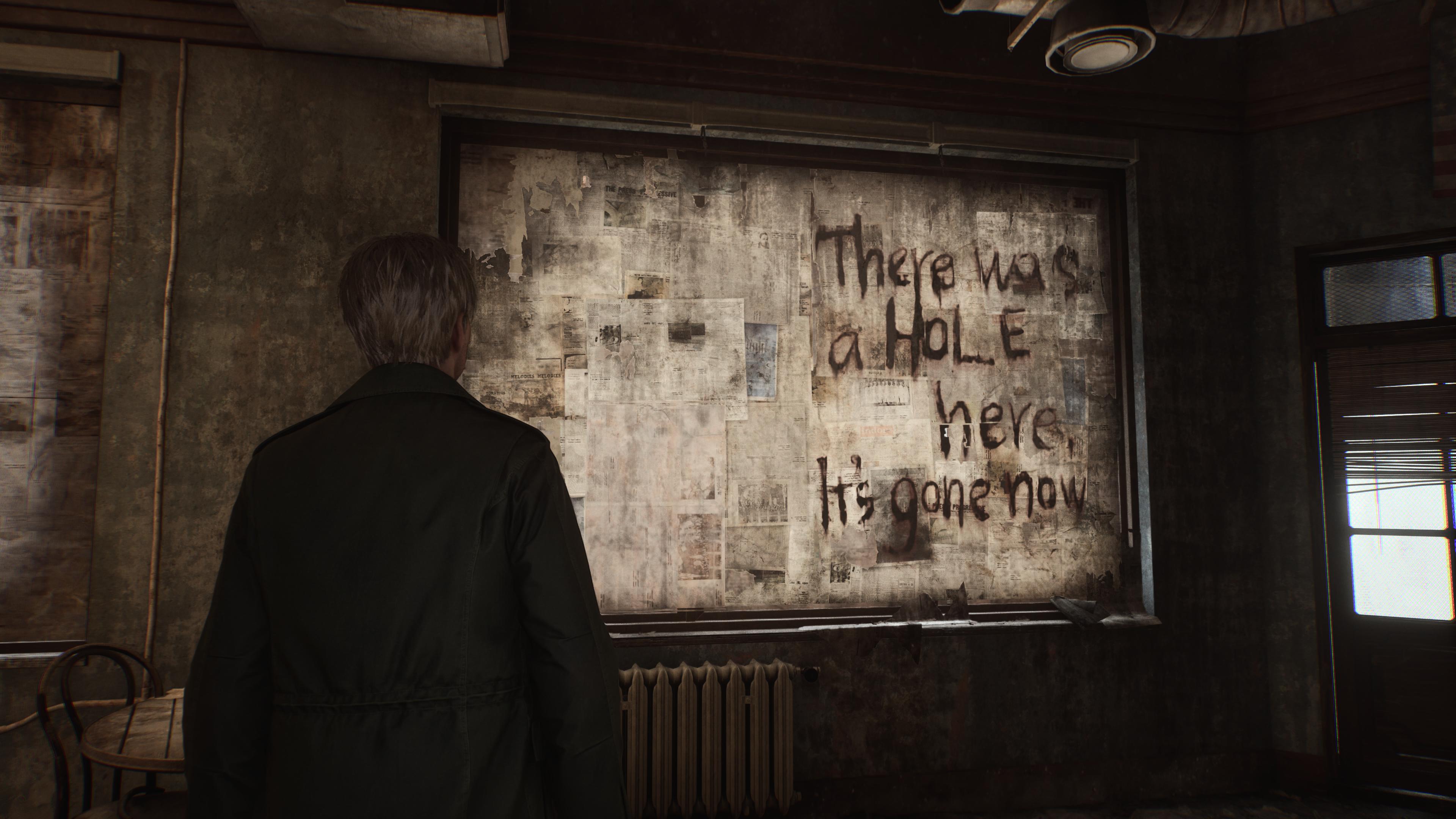

Following a trail of clues, you move through increasingly corrupted locations: apartment complexes, hospitals, prisons, and beyond. Between enemy encounters, you uncover fragments of the town’s history and James’s own past through cryptic notes. Strange puzzles - often involving misplaced objects, notes, and locked containers - offer vague symbolic insight into James’s psychological turmoil. They can be confounding at first, but tend to become obvious once you explore thoroughly and gather the right items.
At certain points, the suffocating fog gives way to an even deeper horror as you slip into the Otherworld. These transitions are subtle—almost imperceptible. Suddenly, you realize you’re trapped in a pure nightmare, where enemies grow tougher and more numerous, and visibility is reduced to the narrow cone of your flashlight. Inspired by Jacob’s Ladder (1990), these segments possess a distinctly stygian quality: rusted steel grates intertwined with fleshy matter, governed by dream logic rather than reason.


As a work of art and psychological horror, I still prefer the original PS2 release. Its pacing is tighter, with significantly less, albeit clumsier, combat. The stiff, awkward acting is even more detached, rendering the dialogue almost surreal and enhancing the otherworldly atmosphere. The disorientation caused by fixed camera angles steepens the experience in a constant sense of dread.
As a video game, however, the Silent Hill 2 remake is a clear improvement. Combat is smoother, progression more intuitive, and the visual design masterfully capture the town’s alienation. It’s a story of depression set within a place that seems intent on pushing you over the edge. James carries the aura of a defeated man from the very beginning, wearing his green jacket like a war veteran. His struggle is already behind him; now he’s ready to face the consequences.
Comments
Post a Comment