
THE FLOP TO END ALL FLOPS

Unknown 9: Awakening is one of the strangest cases of overreach I’ve ever seen. It was meant to be the launchpad for a major AAA franchise—the Unknown 9 brand—a cross-media epic spanning comics, novels, podcasts, and a web series. Reflector Entertainment must have delivered one hell of a pitch to convince Bandai Namco to greenlight this ambitious disaster. Having played the finished product, I’m genuinely stunned. I can’t believe the sheer lack of talent attached to such a massive investment. What the hell happened?
The game became a monumental, Concord-level flop, reaching an all-time peak of just 276 concurrent players on Steam. That number looks even worse when you consider that the game never launched on other major PC storefronts like GOG or the Epic Games Store. In other words, the entire PC audience is reflected in those abysmal figures. Four months after release, while playing it for this review, the concurrent player count was down to nine. I suppose that makes me part of an Unknown 9.


So what went wrong? Where do you even begin? For starters, Unknown 9: Awakening is an atrocious title. Without prior knowledge, what does it tell you about the game’s genre, story, or intended audience? Absolutely nothing. It’s essentially a pretentious way of saying “something unfamiliar begins.”
You play as Haroona, a young Indian woman (voiced by and modeled after Anya Chalotra), raised as a “questar” by her mentor, Reika. Gifted with supernatural abilities, Haroona is apparently the only one capable of stopping an evil organization known as the Ascendants from doing—well—sinister things. You travel across the globe, visiting cities, jungles, mountains, caves, and more, slipping in and out of “The Fold,” a vaguely defined spiritual realm wrapped in poorly explained lore.
The titular “Unknown 9” are an esoteric group of immortal beings attempting to halt civilization’s cycle of death and rebirth. Their actual presence in the game is negligible; only one of them is revealed, and even then their impact is minimal. They were clearly intended to be fleshed out in other franchise entries that will now never exist.


If you’re familiar with Star Wars, Haroona’s questar abilities essentially make her a Jedi without a lightsaber. Everything and everyone is connected to “The Fold,” a metaphysical force she can manipulate at will. In combat, this translates to a grab bag of abilities: pushing enemies into walls, pulling them close for melee attacks, ripping souls from bodies for stealth takedowns, generating protective force fields, briefly turning invisible, and even possessing enemies to make them attack one another.
On paper, it sounds promising. In practice, none of it amounts to much—neither narratively nor mechanically. Haroona is trapped in a muddled story with no clear end goal. You’re told to stop the Ascendants, but their objectives are so opaque that I never fully understood what they were trying to accomplish, even after finishing the game. I’ll admit I lost interest in the story fairly early. From that point on, I simply trudged through the linear levels on autopilot, barely comprehending Haroona’s motivation. What initially resembled a revenge plot quickly morphed into something else entirely—and that’s when I stopped caring.
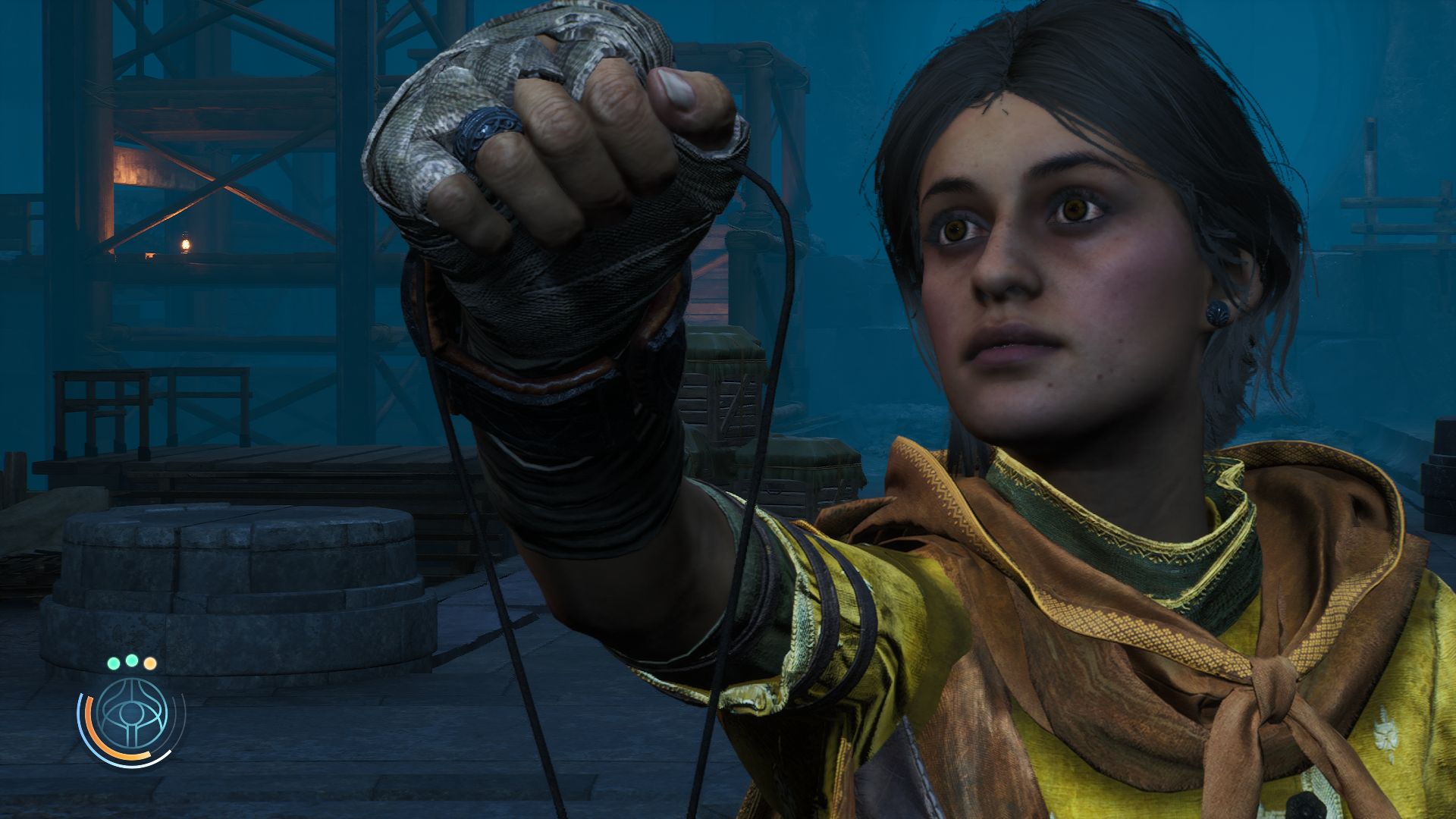

Haroona herself doesn’t help matters. Early on, she’s insufferable. She rejects help at every turn, treats allies with open hostility, and radiates disdain toward anyone who means well. There are only two possible explanations: either she’s written as a “girlboss,” or her arc involves learning to trust others. Thankfully, it’s the latter—but it takes far too long to get there.
Between chapters, you return to an airship hub where you can interact with a small cast of side characters. They’re an aggressively diverse ensemble: an American cowboy, a Norwegian pilot and her engineering-minded daughter, an aging Italian opera enthusiast, and others. They’re likable enough, but largely underutilized. For the game to earn a true bonus diversity score, I would have expected at least one ginger, one albino, an epileptic, an Eskimo, and perhaps someone with chronic kidney disease.


The lore, initially intriguing, quickly collapses into generic end-of-the-world nonsense. It’s an apocalypse that is never shown, felt, or meaningfully implied. No disasters, no visible consequences, no sense of urgency—just vague warnings. The game throws around concepts like cycles of life, conduits, spiritual realms, mana, magicians, and religious fanatics, all with fresh labels slapped onto ideas scavenged from the fantasy recycling bin. Scratch the surface and there’s nothing underneath.
Weak storytelling isn’t helped by the repetitive gameplay loop, which consists of stealth, combat, combat-flavored stealth, and stealth-flavored combat. Following in the footsteps of linear, narrative-driven action adventures like The Last of Us and A Plague Tale, the game tries—and fails—to replicate their tension and pacing.

You sneak through tall grass or hide behind crates, attempting to ambush enemies or trigger environmental hazards. Explosives, poison gas, and electric traps are available, but they mostly chip away at enemy health. The only reliable instant kill comes from stealth takedowns from behind. If you’re detected, Haroona’s invisibility lets you disengage—something you’ll want to do, because the melee combat is dreadful.
The camera struggles to keep up despite a lock-on system, with enemies frequently attacking from off-screen. Haroona’s extensive list of powers results in cluttered, unintuitive controls, and they’re introduced far too quickly to ever feel natural. Worse, they don’t always respond properly, as if movement inputs randomly override and cancel other actions.

Surprisingly, the handful of boss fights scattered throughout the game are better than expected. Styled after Sekiro: Shadows Die Twice, complete with named bosses and prominent red health bars, they at least attempt to test timing and reflexes. Don’t get me wrong—they’re still bad—but not the catastrophe you might expect. Unfortunately, unlimited healing makes them trivial, while their bloated health pools ensure they drag on far longer than necessary.
Aside from a few puzzles, these combat and stealth encounters make up the entirety of the game. They’re far too frequent, especially toward the end, and show almost no variation. Worse still, progression is often gated until every enemy is killed. You can’t simply sneak past threats like you would in a competent stealth game—the exit remains locked until the room is cleared.

Everything is further undermined by technical instability. At one point, several of Haroona’s abilities—including takedowns and invisibility—stopped working entirely. After dying and reloading a checkpoint, they magically returned. Later, an enemy became stuck on a ledge, preventing progression until I lured him down. Near the end of the game, I lost access to my journal and upgrade menus and had to restart entirely.
The jank extends beyond combat. In exploration, the dodge and contextual jump share a button, and finicky triggers often cause the jump to fail. You’ll frequently dodge at the edge of a cliff instead. Ordinarily this would be disastrous, but invisible walls are so prevalent that the game actively prevents you from falling.

Visually, the game is an embarrassment. At its worst, it looks like a late-era PS3 title. Character models are shockingly bad, especially facial animations. Haroona’s blank, lifeless stare drains all emotion from dramatic cutscenes. In the city chapter, crowds consist of the same handful of hideous models with slight color variations. Some look like victims of botched face transplants.
The exterior environments are serviceable—Indian cities, blue-tinged forests, caves, sunlit cliffs—but their strict linearity makes exploration largely pointless. Short side paths lead to Gnosis points for upgrades or lore collectibles, none of which are compelling due to the vagueness of the world-building.

Consider this excerpt from the lore: “The Cambrian will be a lens through which the life-form can be bound to a host’s neural matrix.” It sounds intelligent to whoever wrote it, but most readers will have to reread it multiple times before realizing it answers questions no one would ever ask. This is Unknown 9’s lore in a nutshell: impenetrable blandness.
As if that weren’t enough, the game sprinkles in insultingly simple puzzles—basic Pipemania-style node rotations involving the flow of “Am” (mana/life force). The solution is often to click each node once.


Unknown 9: Awakening desperately wants to feel like the beginning of a grand adventure, but the skill simply isn’t there. As the first entry in a cross-media franchise, it’s crushed under the weight of its own self-importance, undone by poor production values and shallow storytelling. While post-launch patches have addressed some technical issues, the core concept is fundamentally broken. Fixing it would require scrapping everything and starting over.
I was hoping for something hilariously bad. Instead, I was bored out of my mind. I felt detached, almost dissociated, as if my spirit had been trapped in The Fold while my body slumped awkwardly in a gaming chair, mechanically pushing forward. I could see my own face reflected in the screen—an expression of concern, frustration, and quiet despair. Honestly, a photo of that face might have sufficed as this entire review.
And finally, a word to Anya Chalotra: in the future, choose more carefully where you lend your face. Someone might just butcher it—as Reflector did here. I have a feeling she won’t make this mistake again anytime soon.
Comments
Post a Comment